
Professional Email vs Free Email: Why Your Business Needs a Custom Domain Email
The Email Address That Answers for Your Business
When a customer, supplier or partner wants to reach you, your email address is often the first thing they see. If that address ends in gmail.com, yahoo.com or outlook.com, it says something about your business, whether you mean it to or not.
More than 300 billion emails are sent and received every day, according to Radicati’s email statistics report, and the address those messages come from shapes how the person on the other end judges you.
TIP: A business that still runs on a free personal account looks like a side project. A business with an address that matches its own domain looks established, and that impression matters long before anyone visits your website.
This article compares free email accounts with professional email hosting on your own domain, and explains what switching involves.
What’s The Difference Between Free Email and Professional Email?

Free email services such as Gmail, Yahoo Mail and Outlook.com are built for individuals. You get a mailbox, decent spam filtering and an address that belongs to the provider. If the provider decides to change its terms, limit its storage or suspend accounts, you have little say in the matter.
Professional email hosting works differently. You own a domain name, such as yourbusiness.com, and your email addresses are built on top of it. Instead of [email protected], you get [email protected]. The mailbox is hosted on your provider’s servers, but the address and the domain are yours.
The practical difference shows up in four areas: how your brand appears, how your messages are delivered, how secure your communication is and how much control you keep.
Branding
Every email you send carries your brand. A custom domain email puts your business name in front of every recipient, on every message, in every reply chain. That repetition builds recognition in a way a free provider’s domain never can. Your staff get addresses too, so [email protected], [email protected] and [email protected] all reinforce the same brand instead of a jumble of personal accounts.
Deliverability
Internet providers and spam filters judge email by the reputation of the domain it comes from. Messages from a business domain with proper authentication are more likely to reach the inbox. Messages from a free address are more likely to be flagged or buried, because those domains are used by spammers at scale.
TIP: If your invoices, quotes and proposals keep landing in spam folders, a custom domain email fixes a large part of that problem.
Security
With professional email hosting you get authentication records such as SPF, DKIM and DMARC, plus encryption and server-level spam and virus protection. These stop other people from spoofing your domain and sending phishing messages in your name. Around 3.4 billion fake emails are sent every day, and a business domain without proper protection is an easy target.
Control
Free providers can change their terms whenever they like, and they make money from your data. With email on your own domain, you decide who has accounts, how mail is organized and where your data lives. If you ever change providers, the domain and the addresses move with you. If you are on a free account, the address is the provider’s property, not yours.
What Free Email Really Costs Your Business
A free email account has no monthly bill, but it carries costs that are harder to see.
Customers look for signals that a business is legitimate, and a gmail.com address on a business card is one of the strongest signals that it is not. It suggests the business could not be bothered to set up properly, and it makes customers wonder what else is half-done. Our guide to personalized email addresses covers why the address itself shapes that perception.
Your sales emails, follow-ups and invoices are the lifeblood of the business. If they land in spam, they do not exist. Free domains carry the reputation baggage of millions of other users, and that directly hurts your open rates.
If a key employee leaves with a free account that holds customer conversations, you cannot retrieve those messages. With domain-based email, you keep the accounts and the data. You can create shared mailboxes for the whole team and remove access when someone leaves.
Personal free accounts do not give you the authentication and monitoring tools that a business needs. If someone impersonates your business with a lookalike address, the damage is done before you find out.
What Professional Email Hosting Includes
Professional email hosting does not need to be expensive. Westhost’s email hosting plans start at 50 cents a month, both with a 30-day money-back guarantee, 24×7 support and access from any device.
Personal Email
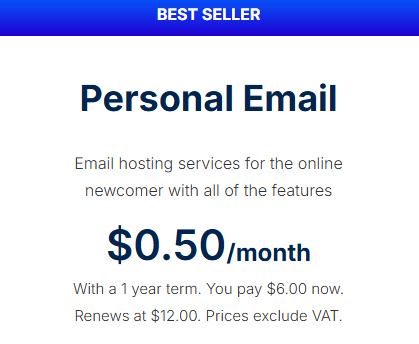
Costs $0.50 per month for the first year. It includes 2GB of storage per mailbox, attachments up to 10MB and up to 100 mailboxes. You get POP and IMAP support, a webmail client with an address book, spam and virus protection, TLS encryption and syncing across iOS and Android devices. If you need more room, you can add storage up to 60GB per mailbox.
Professional Email
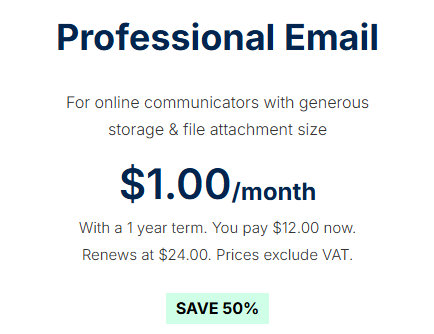
Costs $1.00 per month for the first year. It includes 10GB of storage per mailbox, attachments up to 25MB and up to 100 mailboxes, along with the same security, syncing and support features. It suits businesses that send and receive larger files, such as designers, agencies and consultants.
Both plans let you create addresses like [email protected] and [email protected], set up auto responders and personalized junk mail filters, and read email in Outlook, Thunderbird or any IMAP-compatible app. Westhost also includes an ad-free webmail client, so you are not locked into one app. If you are still deciding what your addresses should look like, our tips for choosing email addresses walks through the options.
The Case For Making The Switch
The strongest argument for a custom domain email is that it pays for itself. Email is 40 times more effective at acquiring new customers than Facebook or Twitter, according to Campaign Monitor’s analysis of McKinsey research. That return only works if your messages actually reach the people you send them to.
A professional address improves deliverability, which improves the return on every email you send.
There are also practical reasons that compound over time. Every new team member gets a branded address instead of a personal one. Customer conversations stay with the business instead of following a departing employee. Your domain grows in value as a communication asset, and it connects directly to your website.
If you do not have a domain name yet, you can register one from $0.99 for the first year, and Westhost includes free email forwarding with every domain, so you can point mail at your existing accounts while you plan the move. The domain name is the foundation, and professional email is built on top of it.
How to Move From Free Email to a Custom Domain Email
The switch is simpler than most business owners expect. First, register a domain name if you do not already own one. Then choose an email plan and set up your addresses. You can keep your old free account running for a while, forward messages from it and tell your regular contacts about the new address. Within a few weeks the old account can be retired, and every message you send carries your own domain.
You do not need to be technical. Westhost handles the server-side setup, and the email knowledgebase covers the rest, from connecting Outlook to configuring your phone. The 24×7 support team is there if you get stuck.
Frequently Asked Questions
Yes, for a few dollars a month you get a branded address, better deliverability, proper security and full control of your accounts. It is one of the cheapest credibility upgrades a small business can make.
Gmail itself is a free personal service, so you cannot put your domain on it. Google’s paid Workspace product allows custom domains, but you can get the same professional email on your own domain for a lower price with Westhost, with support and security included.
IMAP keeps your email on the server and syncs it across all your devices, so a message you read on your phone is marked as read on your laptop. POP downloads messages to one device. For business use, IMAP is the better choice, and Westhost supports both.
Both Westhost email plans support up to 100 mailboxes, so you can give every employee a branded address and still have room to add departmental accounts such as sales@ and support@.
A properly configured custom domain email is less likely to be marked as spam than a free address, because the domain’s reputation is yours to build. Westhost includes SPF, DKIM and DMARC authentication records that help keep your messages out of the spam folder.
Yes, because the domain is yours. If you move to another provider, your addresses move with you. That portability is one of the biggest advantages of domain-based email over a free account.